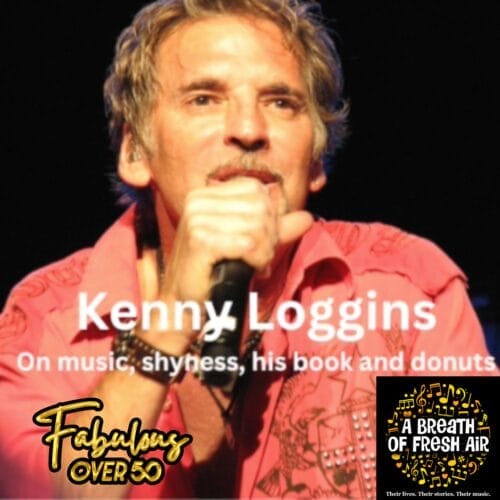
Kenny Loggins is A Breath of Fresh Air
Welcome to our marathon! The winners of our 50 Over 50 Podcaster awards are sharing their episodes with us. Today we have the privilege of hearing from Sandy Kaye, who chose to contribute her interview with Kenny Loggins.
Early Inspiration: A Shy Kid with Big Talent
Sandy Kaye speaks with soft rock legend Kenny Loggins to discuss the fascinating journey that transformed an introverted, guitar-strumming teenager into one of the most recognizable names in music. Contrary to the urban legend that he began writing songs at seven, Loggins admits his true songwriting journey started in high school, inspired by his older brothers and the musical titans of the 60s—Lennon and McCartney, Bob Dylan, and the folk and R&B movements.
Loggins’s innate creativity poured forth in both poetry and music. “Some part of me wrote the song automatically,” he recalls, likening the experience to poetry assignments in school where the words seemed to flow effortlessly. His earliest compositions came while taking guitar lessons, marking the start of a prolific career.
Breaking Through: House Parties and Pooh Corner
Before international stardom, Loggins honed his craft as a staff writer, earning just enough to pay his modest rent. One fortuitous evening at a Los Angeles party, he found himself singing with members of the Nitty Gritty Dirt Band, eventually leading them to record “House at Pooh Corner.” With several of his songs making it onto their album, his music gained a vital early audience.
Loggins shares that “House at Pooh Corner” was not, as many believe, written as a children’s song. Instead, it was a personal farewell to childhood, composed during his final year of high school. By happenstance, his casual romance with the daughter of Disney’s CEO helped him secure rights to the beloved Pooh characters, affirming that sometimes, it really is “who you know.”
Magical Partnerships: Harmony with Jim Messina
The podcast delves into the celebrated partnership with Jim Messina, with whom Loggins formed the iconic duo Loggins and Messina. Their unique vocal blend, influenced by the Everly Brothers, struck a special chord. Although they initially thought of their collaboration as a one-off project, industry pressures led to a six-year commitment—and a touch of creative rivalry that fueled their individual growth. Ultimately, both amicably went solo, with mutual admiration and enduring friendship.
The Solo Evolution: Hits, Soundtracks, and Staying Grounded
As a solo artist, Loggins charted a fresh direction, drawing from R&B and refining his signature sound, sometimes dubbed “yacht rock.” Collaborations with the likes of Stevie Nicks and Michael McDonald resulted in Grammy-winning hits such as “This Is It,” and his knack for crafting infectious, emotional tunes powered blockbuster soundtracks like Caddyshack, Footloose, and Top Gun.
This episode offers glimpses into how Loggins stayed grounded amid all the acclaim. Family life and relationships kept him tethered to reality, as did the teasing comments from his children about his lack of “real-life” experience. Life on the road was balanced out by simple chores at home—“You may be hot out there, but here, you take out the garbage,” his wife reminded him.
Giving Back: Mentorship, Environment, and Community
Later in his career, Loggins’s focus shifted to causes close to his heart. His song “Conviction of the Heart” became an environmentalist anthem, even catching the attention of Al Gore. Locally, he champions charity work with organizations like Unity in Santa Barbara, feeding and clothing families in need.
Equally important is his passion for mentoring young musicians. “When I work with young people, I see myself in them,” he says, continually inspired by their creativity. Loggins finds meaning in teaching songwriting clinics and sharing the wisdom earned across decades of musical invention.
The Next Chapter: Reflection and Renewal
Despite accolades and an impressive discography, Loggins remains refreshingly humble. Writing his memoir, Still Alright, proved a cathartic challenge—a blend of “deposition and therapy.” Even in recounting lost master tapes, miraculous recoveries, and career highs, he approaches life with gratitude, humor, and a forward-looking spirit.
As he continues to create—recently composing the title song for a forthcoming documentary—Kenny Loggins exemplifies the art of reinvention, the power of collaboration, and the joy of a life well-lived. On and off the stage, he remains, in his own words, “still alright.”
For more information about Sandy Kay and her podcast, plus lots of other episodes head to https://www.abreathoffreshair.com.au
Connect with me (Jen):
Contact: https://www.jenhardy.net/contact
Instagram: https://www.instagram.com/thejenhardy
Facebook: https://www.facebook.com/fabulousover50show
YouTube: https://www.youtube.com/
Twitter: https://www.twitter.com/thejenhardy
LinkedIn: https://www.linkedin.com/thejenhardy

TRANSCRIPT for Kenny Loggins: A Breath of Fresh Air
Sandy Kaye [00:00:02]:
It was a beautiful day. Wow. I feel good. It’s a beautiful day I can’t stop myself from smiling. Welcome to A Breath of Fresh Air with Sandy K. Cuz it’s a beautiful.
Kenny Loggins [00:00:19]:
Day here A breath of fresh air.
Sandy Kaye [00:00:25]:
Beautiful day oh, baby any day that you’re gone away It’s a beautiful day.
Sandy Kaye [00:00:36]:
Hi. Thanks so much for joining me today. I’m really glad you could make it along. I’ve got a fabulous interview coming up for you this hour, and I know you’re just going to love it. My guest has had such an incredible career that he really is a household name the world over. He’s soft rock singer, songwriter, guitarist, pianist, and producer Kenny Loggins. He’s had a consistent string of hits through the 70s, 80s and 90s, and he’s recently released his autobiography, Kenny Loggins played in several bands in the late 60s, honing his songwriting chops as a staff writer at a music company. He rose to prominence as part of the duo Loggins and Messina with fellow singer and songwriter Jim Messina.
Sandy Kaye [00:01:26]:
Even though we ain’t I’m so in love with your honey Everything will bring a chain of love.
Sandy Kaye [00:01:40]:
Kenny Loggins has had hit after hit after hit both as a solo performer and writer since his time with Jim Messina. His gift for crafting deeply emotional music is unparalleled, and it’s been part of his life for as long as he can remember. In fact, if what I read is correct, he was no more than around seven years old when he wrote his first song.
Kenny Loggins [00:02:05]:
I don’t know about that. That’ll be the urban legend. That I was interested in rock and roll and songwriting early on was probably because of my two big brothers. I had watched them trying to write a song together and getting nowhere, and I remember thinking, it can’t be that difficult. And I really didn’t start writing until I was probably a junior in high school. Then while I was taking guitar lessons, I just automatically started writing songs.
Sandy Kaye [00:02:31]:
And was it as easy as you thought it was?
Kenny Loggins [00:02:34]:
It kind of was, because I found that there was some part of me that wrote the song automatically. It was almost like the same thing with poetry when I was in school, and they’d say, oh, we want you guys. Take an hour and write a poem. This thing would just pour out and I don’t know where this is coming from, but it’s kind of fun and easy. And so I pursued it. Partly, as they say, part of it is the inspiration and part of it is, you know, how do you craft a song? How do you Craft a lyric. And that took time.
Sandy Kaye [00:03:02]:
So where did you learn that from? Was that just being thrown in the deep end and working it out as you went?
Kenny Loggins [00:03:07]:
I think so, yeah, it was. You know, I was a student of Lennon and McCartney and of course, Bob Dylan. And, you know, I came through the folk era. But I also was a big fan of rock and roll and R and B. Cause I had two big brothers. You know, as you get into it and as you start to work at it, you see what’s working and what isn’t working. And you begin to get ideas about how to make what you’re doing sound more like a real song.
Sandy Kaye [00:03:34]:
Yeah, well, you scored a job working for a music company as a staff writer there, which must have given you a great boost. But the first big break, as I understand it, came along when Nitty Gritty Dirtband actually recorded some of your work.
Kenny Loggins [00:03:47]:
That’s right.
Sandy Kaye [00:03:48]:
Christopher Rob and I walked along under branches lit up by the moon Posing our questions to owl and de or as our days disappear all too soon But I wandered much further today than I should and I can’t find my way to the Three Acre Wood so help me if you can I’ve got to give back to the house if you con by one you’d be surprised there’s so much to be done Count all the bees in the house Chase all the clouds from the sky.
Kenny Loggins [00:04:40]:
Had a job as a songwriter. $65 a month for ABC Wingate. And for that they got House of Pooh Corner and a few other standards and some early Logins and Messina stuff. And where I would get my songs heard was I would go to different parties around town. And just one particular party that I went to, there were a couple guys there from the Nitty Gritty Dirt Band. And we were all sort of sitting in a circle, trading tunes. And one thing led to another, and I showed them House of Pooh Corner. I showed them half a dozen of my songs.
Kenny Loggins [00:05:12]:
They wanted to record House of Pooh Corner. And then they turned me on to their manager, John McEwen. And John really loved what I was doing. So they had about four or five of my songs on their Uncle Charlie album. And that was the beginning of getting my stuff heard.
Sandy Kaye [00:05:26]:
Amazing. You must have thought you were eaten a bit working for that $65 at the time, did you?
Kenny Loggins [00:05:32]:
Yeah. Well, I considered myself lucky because my rent was $65 a month. So I always say. I always say it wasn’t 1909. It was just a shitty place to live. But it all worked Out.
Sandy Kaye [00:05:44]:
And Jim tells the story about the two of you meeting actually through one of your brothers. Is that right?
Kenny Loggins [00:05:49]:
Right. My brother Dan became an A R man for Columbia Records years later. And when he first was signed on by Clive Davis to go into training for A and R, he and his best friend, Don Ellis, who would become the president of RCA Records, they grew up together. And they met Jimmy Messina. So they connected me and Jimmy together.
Sandy Kaye [00:06:13]:
And you’d been a fan of Buffalo Springfield, hadn’t you?
Kenny Loggins [00:06:16]:
Oh, yeah, absolutely. It was one of my big influences was Stephen Stills in Buffalo Springfield.
Sandy Kaye [00:06:23]:
Yeah, there’s something happening here but what it is ain’t exactly clear There’s a man with a gun over there Telling me I got to beware I think it’s time we stop Children what’s that sound? Everybody look what’s going down there’s battle lines being wrong Nobody’s right if everybody’s wrong Young people speak in their minds Are getting so much resistance from behind Time we’re stopped hey, what’s that sound?
Kenny Loggins [00:07:20]:
Everybody look what’s going down.
Sandy Kaye [00:07:28]:
So you and Jim, when you got together, what was the magic between the two of you? Was it the way you harmonized, the way you wrote? Can you explain what it was that clicked?
Kenny Loggins [00:07:37]:
You know, of course. You know, that’s an impossible question to answer because. Explaining the magic of a combination. But we definitely. I heard the Eberly Brothers in our. In our voices early on. There was an Eberly’s quality that we wanted to exploit, just as the Beatles did. The Beatles rarely gave the appropriate nod to the Eberly Brothers, but you can hear it in their early work especially.
Kenny Loggins [00:08:00]:
But there was that kind of Everleigh’s blend in our voices that caught our attention right away. And we were both very nasal singers, so it all kind of blended together. And I think there was magic in that. And also, Jimmy had some great songs that he had not been allowed to sing in Poco. And when he showed them to me, the first one I did, we initially thought we were making a Kenny Loggins record produced by Jimmy Messina. That’s. I’m sure he told you. And so he gave me his song Peace of Mind to work up for the Kenny Lagga’s record.
Kenny Loggins [00:08:34]:
And that’s the only song you’ll ever hear, only Jimmy Messina song you will ever hear Kenny Loggins singing. And that’s when we realized, oh, this is. This is a.
Sandy Kaye [00:08:48]:
Friend who isn’t care. A friend indeed or the friend that you need who can help you through the troubled times so Reach on out and take the hold of my hand. Let me know that you’re ready to go. There ain’t no dosing. You can leave your fears behind.
Kenny Loggins [00:09:10]:
And.
Sandy Kaye [00:09:11]:
Have a little peace. Just a little beside me. There comes a time when your friends go blind and the words become diseased. They’ll threaten your life with the blade of an appetite. Set you down upon your knees. Make no mistake Be your very own sake. Here’s a little worth of that. Take off your shoes.
Sandy Kaye [00:09:57]:
Let your thumbs be care and have a little peace. Just a little peace of mind. Peace, Peace of mind.
Kenny Loggins [00:10:18]:
Even at that point, we hadn’t really thought of ourselves as a duo band. We thought of ourselves as a one time, one record duo. That’s why he came up with the idea of calling it Sitting In.
Sandy Kaye [00:10:30]:
So you didn’t think that you’d have a future together.
Kenny Loggins [00:10:33]:
We weren’t thinking of it that way. We figured the first record would be Kenny Loggins with Jimmy Messina sitting in, like a jazz record thing. And then the next record would be Kenny Loggins produced by Jimmy Messina. But Clive did not like the idea of promoting a band that was going to break up. So he insisted that he would not release Sitting in unless we committed to a six year deal.
Sandy Kaye [00:10:55]:
Were you reluctant to do that?
Kenny Loggins [00:10:57]:
Well, it caught me by surprise, as you can imagine. But at the same time I thought, yeah, there’s definitely a chemistry here. We’re really clicking and we’re having fun. So, sure, yeah.
Sandy Kaye [00:11:07]:
Pay me big time.
Kenny Loggins [00:11:10]:
You’re right.
Sandy Kaye [00:11:12]:
Time and again I’ve seen years staring out at me now Feeling again. I wonder what it is that you see with those angry eyes. Well, I bet you wish you could cut me down with those angry eyes. You want to believe that I am I’m not the same as you. I can’t conceive oh Lord of what it is to try to do with those angry eyes. But I bet you wish you could cut me down with those angry eyes. What a shot you could be if you could shoot at me with those angry eyes.
Sandy Kaye [00:12:21]:
You were writing a whole lot of songs yourself at that time. And one of my favourites was Danny’s song. That was a very personal song to you, wasn’t it? Because it was about your brother having his first child.
Kenny Loggins [00:12:33]:
Right? Right. A lot of it was taken from a letter that he wrote to me after Colin, his son, was born, and telling me that they were going to get married and move to Northern California. And so, you know, he will be like she and Me. As free as a dove was sort of A paraphrase of one of the lines from the letter Pisces. Virgo rising is a very good sign. That was from the letter.
Sandy Kaye [00:12:53]:
People smile and tell me I’m the lucky one and we’ve just begun. Think I’m going to have a son. He will be like she and me as conceived in love sun is going to shine above Even though we ain’t got money, I’m so in love with honey and everything will bring a change. Oh, and in the morning when I rise, you bring a tear of joy to my eyes and tell me everything’s gonna be alright. Seems as though my. A month ago I was Beta Kai never got high, oh, was a sorry guy but now a smile, a face, a girl that shares my name yeah, now they’re through with the game this boy will never be the same. And even though we ain’t got money, I’m so in love with the honey Everything will bring a chain of love in the morning when I rise Bring a tear of joy to my eyes and tell me everything’s gonna be alright.
Sandy Kaye [00:14:41]:
What got you right into children’s songwriting?
Kenny Loggins [00:14:44]:
I didn’t perceive House of Poor Corner as a children’s song when I wrote it. It was a song of farewell to my childhood from the point of view of being a senior in high school about to graduate, and some part of me knowing that my childhood was over. At least I thought it was. It comes back when you have kids of your own. But to me, that was just, you know, I wrote myself into that story in that song. I didn’t realize that I was, you know, I was, what, 16, 17? I didn’t realize that I’d have to get permission from whoever owned Winnie the Pooh, and that would be the Disney Corporation not long after that.
Sandy Kaye [00:15:25]:
But you didn’t. You did manage to get that permission, obviously.
Kenny Loggins [00:15:28]:
Well, I was dating the daughter of the CEO of the Disney Corporation.
Sandy Kaye [00:15:32]:
That always helps.
Kenny Loggins [00:15:34]:
Yeah, you got to go to the top, right? But I didn’t really realize that until, you know, I met her and we got into this. It wasn’t really a relationship, very casual dating thing, but. But she introduced me to her father and I sang the song to her dad. And then he called the lawyers.
Sandy Kaye [00:15:50]:
Better than calling the police.
Kenny Loggins [00:15:52]:
Yeah, right. Could have found that way, I suppose.
Sandy Kaye [00:15:54]:
Were you a bit of a celebrity at school?
Kenny Loggins [00:15:56]:
No, not really. No. I was very shy and, you know, big ears, buck teeth for quite a while. And so the shyness and the music was my way of getting around that shy, introverted self. But that took Time, you know, it took a while to develop that part of myself.
Sandy Kaye [00:16:15]:
So you were kind of that geeky boy in the corner, writing songs and strumming a guitar.
Kenny Loggins [00:16:20]:
Yeah. There. But for fortune, I would have been Elvis Presley. Elvis. Not Elvis Presley. Elvis Costello. Just kind of sitting there with my glasses on.
Sandy Kaye [00:16:30]:
Christopher Robin and I walked along under branches lit up by the moon Posing our questions to owl and the ore as our days disappear all too soon But I wandered much further today than I should and I can’t find my way to the Three Acre Wood so help me if you can I’ve got back to the house at Two Corner by one you’d be surprised. There’s so much to be done. Count all the bees in the house Chase all the clouds from the sky Back to the days of Christopher Robin and Winnie the Pooh doesn’t know what to do Got a honey jar stuck.
Sandy Kaye [00:17:46]:
On his nose House of Pooh Corner sold millions for Kenny Loggins. And unbeknown to him, he was just getting started. Don’t you go anywhere. As this story continues in just a sec, this is a Breath of Fresh.
Sandy Kaye [00:18:02]:
Air with Sandy Kaye. It’s a beautiful day.
Sandy Kaye [00:18:08]:
Thanks so much for hanging in. I’m chatting with superstar Kenny Loggins, who’s just admitted that he was a shy, geeky kid who discovered very early on that he had a natural gift for songwriting.
Kenny Loggins [00:18:21]:
Being in the music business required me to get over being shy and put myself out there and just show up. And it’s the showing up that changes you.
Sandy Kaye [00:18:31]:
How was that for you? That must have been really difficult in the beginning.
Kenny Loggins [00:18:35]:
Yeah, it was. It was. And I wasn’t sure how to go about doing it. And that’s why I think Jimmy was very much a mentor for me in that way. And sometimes there’s good and bad with that mentorship. You know, one is that Jimmy was a mentor and a teacher at the same time. He was a, quote, partner. But we’re both developing solo careers, so there’s a conflict within that partnership.
Kenny Loggins [00:19:00]:
One upsmanship, which I think exists in a lot of bands. I think that’s why bands break up so soon, because they’re trying to one up each other and they’re only 18, 19, 20 years old, so we barely knew who we were at all. And then all of a sudden, we’re enmeshed in this duo and we’re trying to find our individual personalities while presenting the idea of a solid duo to the world.
Sandy Kaye [00:19:24]:
If you’ve been thinking you’re all that you’ve got, then don’t feel alone anymore. Cause when we’re together then you got love. Cause I am the river and we you are the shore. And it goes on and on the most. Watching the river run Further and further from things that we’ve done. Leaving them one by one. And we have just watching the river run. Listening, learning, and tuning to Run River Run.
Kenny Loggins [00:20:17]:
There was a lot to learn about how to show up for not only hiring and firing a band, but, you know, hiring agents, hiring managers, creating a tour, road managers, the whole infrastructure, putting a business together. And Jimmy had been experienced in that area. So I learned a lot from him on that. The positive was I learned a lot. The negative was I learned his way. Then I had to learn, oh, there are other ways to do this.
Sandy Kaye [00:20:42]:
And in pursuit of finding your way. Was that what led to the breakup of the two of you in 1976?
Kenny Loggins [00:20:49]:
Not really. I would say that what led to the breakup was the actual creation of the duo. We were really two solo artists who really just thought of ourselves as soloists who’d come together for one record. And then, okay, so we’re thrown together for six records. Let’s make the most of that. Let’s, you know, share our material as much as we can. But we were both really ready to break up right from the beginning. So when that six year time period came, I was like, thanks.
Kenny Loggins [00:21:17]:
See ya.
Sandy Kaye [00:21:17]:
But you’re still good friends today, aren’t you?
Kenny Loggins [00:21:20]:
Yeah, we’re good. We get along well.
Sandy Kaye [00:21:22]:
Your mama don’t dance and your daddy don’t rock and roll? Your mama don’t dance and your daddy don’t rock and roll. When even all’s around and it’s time to go to town where do you go to rock and roll? The old folks say that you gotta end your day by 10. If you’re out on a date and you bring it all, you just ain’t all these years and you know you’re gonna lose and never win. I’ll say it again.
Sandy Kaye [00:22:00]:
You went off then to find your solo career, and boy, did you find it in a very big way. The following year in 77, you wrote that fabulous song for Barbra Streisand to sing in, A Star is Born. Were the hits just pouring out of you already?
Kenny Loggins [00:22:14]:
Then looking back at it, you could think that I was definitely writing a lot. I was very excited about finally going solo. The metaphor is pulling the arrow back in the bow, right? It was back there for quite a while before we let it go. So I had and I found that my writing in that last year of Lagins and Messina evolved dramatically. I was finding new chords and new ways of putting them together. And I had melodic ideas that were just completely different from anything I’d done before with Loggins and Messina. I knew I was heading in a sort of an R B direction. Years later, someone would dub it yacht rock.
Kenny Loggins [00:22:50]:
But it was really from Celebrate Me Home on that I started moving in a more R B kind of, or R B inflected approach to my music, using more R and B type chordal progressions, and really found myself drawn to that style of music that Stevie Wonder was sort of the spearhead of.
Sandy Kaye [00:23:10]:
Been times in my life I’ve been.
Sandy Kaye [00:23:15]:
Wondering why.
Sandy Kaye [00:23:19]:
Still somehow I believe we always survive Now I’m not so sure you’re waiting here One wouldn’t reason to try right? What more can I say? What’s left to provide? You think that maybe it’s over Only if you want it to be how you going to wait for a sad your miracle Stand up and fight this is it make no mistake where you are this is it. You’re back still a girl now this is it. Don’t be a fool anymore this is it. The winning is about no room to run.
Sandy Kaye [00:24:26]:
Was it taking up every waking moment?
Kenny Loggins [00:24:30]:
No, I still had time to. To get married and things like that. So there’s other waking moments to deal with. But I was very driven. No one had told me that you can’t break out of a successful duo and become a successful solo. I didn’t know what the odds were against me. So I kept doing it because I was naive enough to think, well, that this is going to happen. Just like the first thing happened, now this is going to happen.
Kenny Loggins [00:24:56]:
I’ll just keep going. And really, the moment I think that made the biggest difference in my solo career was meeting Stevie Nicks. When I opened for Fleetwood Mac during Rumors and becoming a friend of Stevie’s. We would hang out in clubs after the shows and stuff. And she had quite an entourage of people that would travel with her. So there was a lot of partying going on. And in the process we became friends as well as Mickey. And then she said, well, if you ever need a singer, give me a call.
Kenny Loggins [00:25:24]:
So, of course, she was by that point the most popular female singer in the world. So, you know, of course I gave her a call. And that. That duet with Whenever I Call youl Friend really broke my solo career.
Sandy Kaye [00:25:37]:
Whenever I call you friend I begin to think I understand and it will be you and I Ever and ever I see myself within your eyes and that’s all I need to show you Everything I do Always takes me home to you me Day by day we can see in every moment There’s a reason to carry on Sweet love sh us of heavenly light I never seen such a beautiful sight See love, learn on a s night I don’t forever we’ll be doing it Sleep and turn us a heavenly light I never seen such a beautiful sight See the flowing on a Saturday night I know forever we’ve been doing it Whenever I call you friend I believe I come to understand Everywhere we are you and I will melt to be Forever and ever I think about the times to come Knowing I will be the lucky one Ever I love will last I.
Sandy Kaye [00:27:27]:
So when your career had that huge boost with whenever I call you friend, how did life change for you then?
Kenny Loggins [00:27:33]:
Well, it changed primarily because I could suddenly play bigger venues, and then that led to bigger audiences, which I could then continue to put in new material, and I just kept working it.
Sandy Kaye [00:27:46]:
Did your head run away with you? Did you let all that fame and fortune get to you, or did you manage to stay grounded?
Kenny Loggins [00:27:52]:
Well, it depends on who you talk to.
Sandy Kaye [00:27:54]:
I’m talking to you.
Kenny Loggins [00:27:57]:
That’s right. I know. I think I managed to stay grounded, but my kids tell me not so much. My oldest son says, dad, you have no idea what real life is like. Because, you know, remember I. I was a so called rock star from the time I was 21 on. So, you know, I never even learned how to cook a burger for myself. You know, it’s like when you’ve got enough money to hire somebody to do that, you do it.
Sandy Kaye [00:28:23]:
So you never had to put out the trash, you never had to walk the dog. All the kind of mundane things that we do.
Kenny Loggins [00:28:30]:
Yeah, not entirely. My first wife, when I would get home from the road, Eva would say, well, you may be hot shit out here, but here you take out the garbage. It’s like, oh, okay, we’ll call that grounding.
Sandy Kaye [00:28:43]:
Right, Good. I’m glad to hear that. I’m chatting with Kenny Loggins. The hits just kept on coming for you, Kenny. And there is a fabulous story about how you got together with Michael McDonald, course from the Doobie Brothers. Would you mind sharing that with us?
Kenny Loggins [00:28:58]:
Of course. I heard Living on a Fault Line, that Doobie Brothers album, when we were beginning Logos of Messina, and I thought, this guy is amazing. I’ve got to write with him. And so I put the word out through management, and I found out through the grapevine that he was Looking for collaborators. So finally we connected. I got a writing date and headed over to his house. And as I was unpacking my guitar out of the trunk of my car, I could hear music coming from the front door of his home. His door was ajar, and I could hear piano things going on.
Kenny Loggins [00:29:34]:
And as I’m walking up to the front door, I hear. And he’s singing, you know, And I couldn’t understand the words because he wasn’t actually singing words. But at one point, he stops abruptly and says to his sister, that’s all I’ve got. And I knock on the door, and my imagination had kept going. And when he stopped playing, my imagination heard what would become the B section of that song. So I knock on the door and I say, hey, Mike, I said, play that thing you were just playing, because I think I know how the next section goes. And so I like to say that we were writing together before we ever met.
Sandy Kaye [00:30:14]:
And, of course, that song won a Grammy for you both, didn’t it?
Kenny Loggins [00:30:17]:
Yeah.
Sandy Kaye [00:30:19]:
He came from somewhere Back in her long ago Watching her life she musters a smile for his nostalgic tale Never coming near what he wanted to say or did you realize it never really was she had a place in his.
Sandy Kaye [00:30:56]:
Life.
Sandy Kaye [00:31:00]:
He never make her day twice as she rises Just do her apology Everybody else would surely know.
Sandy Kaye [00:31:31]:
That was your first Grammy.
Kenny Loggins [00:31:33]:
And then the next year, we wrote this Is it, and that won a Grammy.
Sandy Kaye [00:31:37]:
You were just on fire. It still doesn’t stop, because in the 80s, you ended up with a whole new career, being called the king of the movie soundtrack.
Kenny Loggins [00:31:47]:
Yeah, go figure. What happened was disco. I just happened to get a phone call. Sue, you mentioned when I wrote for Barbara on Star Is Born, I Believe in Love. And in the process of doing that song, Barbra Streisand’s boyfriend at the time was John Peters. And John and I became friends. And then he and Barbara split up, and he started his own production company, and their first project was Caddyshack. So when he was almost done with that movie, he called me and said, would you come check out my movie? I’d love for you to write something for it.
Kenny Loggins [00:32:21]:
So I stopped by his studio, and I watched a rough cut of Caddyshack, and I loved it, laughed all the way through it. And I said, I want to write everything for it. What can I do? So we have other writers, but I want you to write at least a couple of songs. So I think I have four songs in that movie soundtrack. That was the beginning of me Writing for movies. And then my friend Dean Pitchford wrote a screenplay. So I read his screenplay as a favor to Dean. He and I wrote the title song for his screenplay, which was called Footloose.
Kenny Loggins [00:32:50]:
And the next thing you know, he’s got the biggest movie of the summer.
Sandy Kaye [00:32:58]:
My heart forward don’t tell me what I got I’ve got this fear that time still holding me down have you deceived it? Now I gotta cut loose Pull me up from my le.
Kenny Loggins [00:33:50]:
It’S the right place at the right time. So much luck comes into this business.
Sandy Kaye [00:33:54]:
It’s also about who you know and how talented you are, isn’t it?
Kenny Loggins [00:33:58]:
I think, yeah. Well, it’s all of the above, right? It’s. They say to be ready for the opportunities when they arise is the trick. So it’s just, you know, it’s one thing to have that door open, but it’s another thing to have your chops together where you can ride a Footloose and Danger Zone, very similar situation. I was in the studio. I had chosen to write for the volleyball scene of Top Gun because I knew no one else would. So I wrote Playing with the Boys. And while I was in the studio working on that, I got a call from Giorgio Moroder’s office saying, Giorgio needs you to sing this song that he’s got at the top of the movie because the act we had has fallen out thanks to the lawyers.
Kenny Loggins [00:34:41]:
So I was down the street, so I said, okay, I’ll be right there. Next day we’re in the studio and I sing the vocal.
Sandy Kaye [00:35:18]:
Heading into twilight Spreading out her wings Tonight she got you Jumping off the deck Shoving in the overdrive.
Sandy Kaye [00:35:45]:
Toto was the band that was supposed to record Danger Zone. REO Speedwagon were approached, too, and Bryan Adams also declined because he thought the movie was a glorification of war. Stay tuned for more from Lucky. Kenny Loggins.
Kenny Loggins [00:36:01]:
This is a breath of fresh air.
Sandy Kaye [00:36:02]:
With Sandy K. It’s a beautiful day.
Sandy Kaye [00:36:08]:
Welcome back. I’m really chuffed to be chatting with one of the most popular soft rock singers of the 70s, 80s and 90s. Kenny Loggins has enjoyed an amazing career, having sold more than 25 million records. Kenny, your friendship with the late Michael Jackson also proved to be really fruitful because he was the one who pulled you into We Are the World, right?
Kenny Loggins [00:36:30]:
Right. I met him when he was showcasing off the Wall, and we. We became instant friends. And he called me when the Jacksons were doing their reunion tour. And so when We Are the World came around, he called me literally and said, you know, I’ve got a project that I’d like you to be in on. You want to do it? Of course we play Michael Jackson, duh. So I show up and it’s We Are the World. And then he really gifted me by putting me on that front line with the other lead singers.
Sandy Kaye [00:37:20]:
Our own lives, it’s true. We make a better day just you and me.
Sandy Kaye [00:37:30]:
What was it like doing that?
Kenny Loggins [00:37:32]:
It was great fun. It was a Rush standing next to Springsteen and Steve Perry, who I would write with, and Daryl hall and. And. And then all those people on the ensemble, you know, Pointer Sisters and everything. It was coming of age, kind of like being a senior in school instead of a freshman.
Sandy Kaye [00:37:50]:
And of course, it was all for such a fabulous cause. And you’ve always been one for a good cause, haven’t you? Because you’re a deeply committed environmentalist. In fact, I know that you wrote the song Conviction of the Heart. And you actually think this one, of all the songs that you’ve done, is your very best work.
Kenny Loggins [00:38:07]:
I think that the. The album is my best work because I hit a place where, you know, by the time we hit Back to Avalon, which was that probably the album before that, I had hit records, but they were gradually all getting written by other people and produced by other people. And I was getting further and further away from that connection to my own creativity in my own work. So I decided that the next record would be written by me and produced by me. And I would make a full commitment to making that the. The record of a lifetime. And at the same time, my marriage was coming apart, I was going through those changes. Then during the making of the record, I would fall in love with a new person and that relationship would start.
Kenny Loggins [00:38:51]:
So I had this whole cycle, life cycle of death and rebirth happening in my life. And Leap of Faith got to chronicle that. That’s the sort of thing that an artist can wait your whole career to have that moment where everything comes together. Your. Your life and your art is one.
Sandy Kaye [00:39:06]:
Thing where all the dreams that we once had, this is the time to bring them back. What would the promises caught on the tips of our tongues? Do we forget or forget? Let’s hold.
Sandy Kaye [00:39:43]:
It’s interesting you talk about that because it doesn’t matter how famous you are or how much money you have. Those are the sort of life events that you go through like the rest of us and in exactly the same way, don’t you? So it’s. You’re filled with the same emotions, the same problems, and you have to deal with it in the same way.
Kenny Loggins [00:40:01]:
Yeah, except that I get to write about it. My job is to chronicle those emotions, chronicle those changes, and really be willing to look at it and dive deep into it so that I can artistically express what you’re going through. Because we’re all going through it. That’s what life is.
Sandy Kaye [00:40:21]:
So we get to relate to your words. And you use it as a therapy to get through your own situation.
Kenny Loggins [00:40:27]:
Yeah, yeah, it is. And I didn’t really perceive it as a therapy. I just saw it as my duty as an artist to use this opportunity to do something with it and something in a way that it moves other people.
Sandy Kaye [00:40:40]:
Yeah, you moved a lot of people. It even moved the likes of Al Gore, and it became the unofficial anthem of the environmental movement. Is that something that you pursue relentlessly these days, too?
Kenny Loggins [00:40:51]:
Not as actively, but yeah. I’m still involved in one way or another. And I’ve got an organization here in Santa Barbara called Unity, which keeps a focus on the footprint. I’ve been more involved in children’s things, and Unity is very much focused on feeding and clothing those in need. So it’s a closer to home thing.
Sandy Kaye [00:41:12]:
I read something else very interesting about you was that when you’re in concert, fans tend to bring gifts all the time. Kind of sounded like the way they threw the underwear at Tom Jones and the like. And on your website you write, please don’t bring gifts to me. Donate instead, because it can be much more meaningful. What do they bring?
Kenny Loggins [00:41:34]:
Oh, any number of things. But not underwear. It’s not that kind of thing. I remember about 10 years ago, I had an old friend of mine who come to the show, and he was looking from behind backstage through, you know, pulling the curtain aside, and he looked down, he said, geez, man. He said, you used to pull the prettiest girls. Meaning the audience was made up of the prettiest girls. He said, where are they? And I said, that’s them.
Sandy Kaye [00:42:00]:
That’s them today. But I’m sure you’re appealing to a whole lot of younger generations as well, because you’ve endured. Your work spreads into so many different directions. Why the desire to work with kids?
Kenny Loggins [00:42:12]:
I think that when I work with young people, I see myself in them and I want to give to them the things I wish someone would have given to me. Whether it’s learning how to craft a song or just giving someone a leg up in their recording career, it’s very gratifying. The strength as a young person is to invent, to create, to Reform what’s there in a new way. There’s a lot of elasticity in the brain. Then as we get older, that brain becomes more crystallized and we become a depository of information. And so we do become masters at our craft, and we can then share that awareness with those young people who have an awareness of the importance of that mastership. I don’t want to compete. I don’t want to always be running in place, you know, trying to keep up with the latest flavor.
Kenny Loggins [00:43:03]:
It’s absurd. I had my turn and now it’s your turn.
Sandy Kaye [00:43:23]:
Independent heart is all I’ve ever known oh, I believe I have no one to lose and nobody Storm Rainbow in the night Lightning on the sea B in your eyes Never before Magic of life happening my hours right before my eyes oh, now I believe.
Kenny Loggins [00:44:13]:
There’s a.
Sandy Kaye [00:44:13]:
God watching over me.
Sandy Kaye [00:44:18]:
Don’T you find, though, that young people are not interested in the world wisdom of older adults? They think they know it all best. Or is your experience different?
Kenny Loggins [00:44:25]:
Well, of course, both. The one you just described is my own kids. The other experience of teenagers is those who are really hungry for information and want to know what the craft was and may continually be. You know, there are threads that run through every generation of music.
Sandy Kaye [00:44:42]:
How do you pass that information across to young people?
Kenny Loggins [00:44:45]:
Well, I found that there are songwriters clinics all around the country, and if I go to teach at a clinic, invariably I end up in a writing situation. I did a clinic recently for a publishing company, and I ended up in a room with a female singer songwriter who was very cute girl and really great voice. And when I started to explore with her what her influences were, she mentioned Sade. And I said, oh, well, if you’re into Sade, then we want to build this on a bass line. So we came up with a bass line, and as we’re creating the melody, it’s all just coming together. That’s the sort of thing that I like to do.
Sandy Kaye [00:45:38]:
Did you spend the Pandemic sitting on your couch writing, too?
Kenny Loggins [00:45:41]:
No. We got e bikes in my. My lady and I would go out in the morning and find the perfect donut. That’s the season I’m in.
Sandy Kaye [00:45:49]:
It’s wonderful to hear how happy you are. You’ve got 12 platinum albums, pair of Grammys hits on almost all the Billboard charts over several decades. You’re still going. You’ve just released a new book. It’s called still or Right. It’s the memoir from one Kenny Loggins.
Kenny Loggins [00:46:05]:
I was very reluctant to write a memoir because I thought of it as the last thing you do before you die. And finally, I had a publisher talk me into it in interviews. I call it a cross between a deposition and therapy. Because trying to remember all the shit that happened over the years is quite challenging. And that was one of the reasons I was reluctant to do it, was I just didn’t remember all this stuff I wanted to.
Sandy Kaye [00:46:28]:
Yeah, right. I don’t remember anything. How did that process work for you?
Kenny Loggins [00:46:32]:
It took about a year. I have no relationship to time. When I look back on things, they all seem to merge. Except for the birth of my children. I’m really not sure what happened. When we did a lot of interviewing of old friends, road managers, musicians, calling them up and saying, what do you remember about this thing or that thing? One classic example, when I was making Leap of faith, we’re about 2/3 of the way through it, and I was moving my headquarters from Los Angeles up to Santa Barbara, and we loaded a truck up with two 32 track Mitsubishi digital recorders, all our amps and guitars, and on the way to Santa Barbara, it got stolen.
Sandy Kaye [00:47:09]:
Oh, dear.
Kenny Loggins [00:47:10]:
What happened? To be in the truck, unbeknownst to me, were all my master tapes from Leap of Faith. So we didn’t know if that was ever coming back. And I had to make a decision as to whether or not to keep recording overdubs or go back and try to recreate my masters. And so I literally took my own leap of faith. And in my body I felt like, the tapes are coming back. Don’t waste your time re recording the material that’s gonna come back. So I keep going with my overdubs, believing in my heart that masters would show up and that three weeks later, the police find the truck and the master tapes had been moved from the body of the truck to the cab and locked up in the cab. Everything else was stolen and gone.
Sandy Kaye [00:47:50]:
How amazing.
Kenny Loggins [00:47:51]:
I ended up with five singles off that record.
Sandy Kaye [00:47:53]:
But you didn’t put those master tapes in the cab of the truck, did you? Whoever had stolen the truck had moved them to the cab?
Kenny Loggins [00:48:00]:
Yes, Correct.
Sandy Kaye [00:48:01]:
How insane.
Kenny Loggins [00:48:03]:
I suspect that some engineer or engineers had something to do with it, because whoever did it knew the value of those tapes. I think just some general thief wouldn’t have even recognized what they were.
Sandy Kaye [00:48:14]:
Wow, what an amazing story. So the moral of that story is keep the faith.
Kenny Loggins [00:48:20]:
If you wish, that could be your moral.
Sandy Kaye [00:48:22]:
Well, what was yours? I mean, you kept believing that they’d come back and they turned up?
Kenny Loggins [00:48:27]:
Yeah, it was more like I knew they’d Come back. I just knew it. It wasn’t like an exercise in keeping the faith. It just was faith. Is there a moral to that story? I don’t know.
Sandy Kaye [00:48:37]:
Kenny Loggins, you’ve got the book still all right. Why the title?
Kenny Loggins [00:48:41]:
Well, it’s based on the song I’m All Right. We kicked around a lot of other titles, but that was my favorite.
Sandy Kaye [00:48:48]:
I’m All Right Me. Why you got to give me a fight? Can’t you just let it be? I’m, I’m all right don’t know about a word about me. You got to give me a fight. Why don’t you just let me be? Do what you like. Do a little. Naturally. But if it’s the. Yeah, you’re going to disagree.
Sandy Kaye [00:49:22]:
It’s your life. Isn’t it a mystery?
Sandy Kaye [00:49:46]:
You’ve still got those E bikes. You’re still riding them and searching for the world’s best donut.
Kenny Loggins [00:49:51]:
No, I had to stop doing that. It was like they were showing up too much in my gut. But, yeah, we still have the E bikes. We. We took up Pickleball and we play that a lot. We love the game and that’s great exercise. Yeah, that’s about it right now. Special projects when they come up.
Sandy Kaye [00:50:10]:
And still writing new material occasionally.
Kenny Loggins [00:50:12]:
Yeah. There’s a lady out of New York named Dorie Berenstain who’s making a documentary of my life and in the process, she asked me if I would write a title song for it. So I’m in the process of recording that.
Sandy Kaye [00:50:25]:
Fabulous. We look forward to watching that too. What an absolute pleasure to have the opportunity to chat with you, Kenny Loggins. It’s just been terrific. Congratulations on a fabulous career.
Kenny Loggins [00:50:36]:
Thank you. Bye. Bye.
Sandy Kaye [00:50:37]:
I hope you found the chat with Kenny Loggins as interesting as I did. What an incredible career. He’s enjoyed smash hits on Hollywood’s favourite soundtracks, rocking worldwide stages and finding his way into children’s hearts everywhere. His song Danger Zone was recently featured again in the 2022 movie Top Gun Maverick, earning over a million streams per day at its peak. Rest assured, too, that his memoir, still alright, is a fascinating read, as it provides a candid and entertaining perspective on one hell of an interesting life. Thank you for being here again with me today. And don’t forget, if you have a guest that you’d like to hear from, just send me a message through the website. A breath of fresh air, and I’ll do my very best to get that person onto the show.
Sandy Kaye [00:51:31]:
I’ll take my leave of you now and hope you have lots of fun. Until we meet again. Same time next week. Bye now.
Kenny Loggins [00:51:43]:
You’ve been listening to A Breath of.
Sandy Kaye [00:51:44]:
Fresh Air with Sandy K.
Sandy Kaye [00:51:51]:
Way. It’s a beautiful day, close.